
Histamine: Friend or Foe?
Understanding the molecule behind your allergies, your mood, your gut and your hormones.
My personal struggle with histamine -
I still remember the summer I couldn't step outside without my skin erupting. The moment the sun hit my arms, or I walked into a warm room, or did anything remotely physical that raised my body temperature, the hives would appear. Raised, burning welts across my hand and legs and so very itchy. My skin would flush a deep red. The itching was relentless.
I tried to write it off as a heat sensitivity. A quirk. Something I just had to manage around. But it kept getting worse, and eventually it started happening indoors too. If I sat near the window or stood on the balcony for a few minutes in the sun. My body was reacting to things that should have been completely ordinary.
What nobody told me at the time was that this wasn't random. My body was producing more histamine than it could break down, and every trigger, no matter how small, was enough to push it over the edge.
Once I started eating in a way that supported my own biochemistry, understanding which foods were adding to my histamine load, supporting my gut, and addressing the hormonal piece, things began to shift. The hives became less frequent, then rare, and now almost gone. My skin calmed down. I can now enjoy summer again, but I still take lots of precautions.
That experience is a big part of why histamine health is something I talk about with so many of my clients. Because the symptoms are often dismissed or misunderstood, and the root cause goes unaddressed for years. Let's change that.Book a discovery callwith me and let me help you with these symptoms you are facing.
What Is Histamine, Exactly?
Histamine is a chemical compound produced naturally in the body. It plays active roles in the immune system, the nervous system, and the gastrointestinal tract. It is formed from the amino acid histidine, found in high-protein foods like meat, with the help of an enzyme called histidine decarboxylase. Gut bacteria also produce histamine as they break down food.
Histamine is primarily created, stored, and released by mast cells and basophils, immune cells that stand guard against foreign invaders. When a trigger appears, whether that is pollen, ragweed, dust, an infection, or stress, these cells release histamine as part of the body's protective response.
The Enzyme That Keeps Histamine in Check
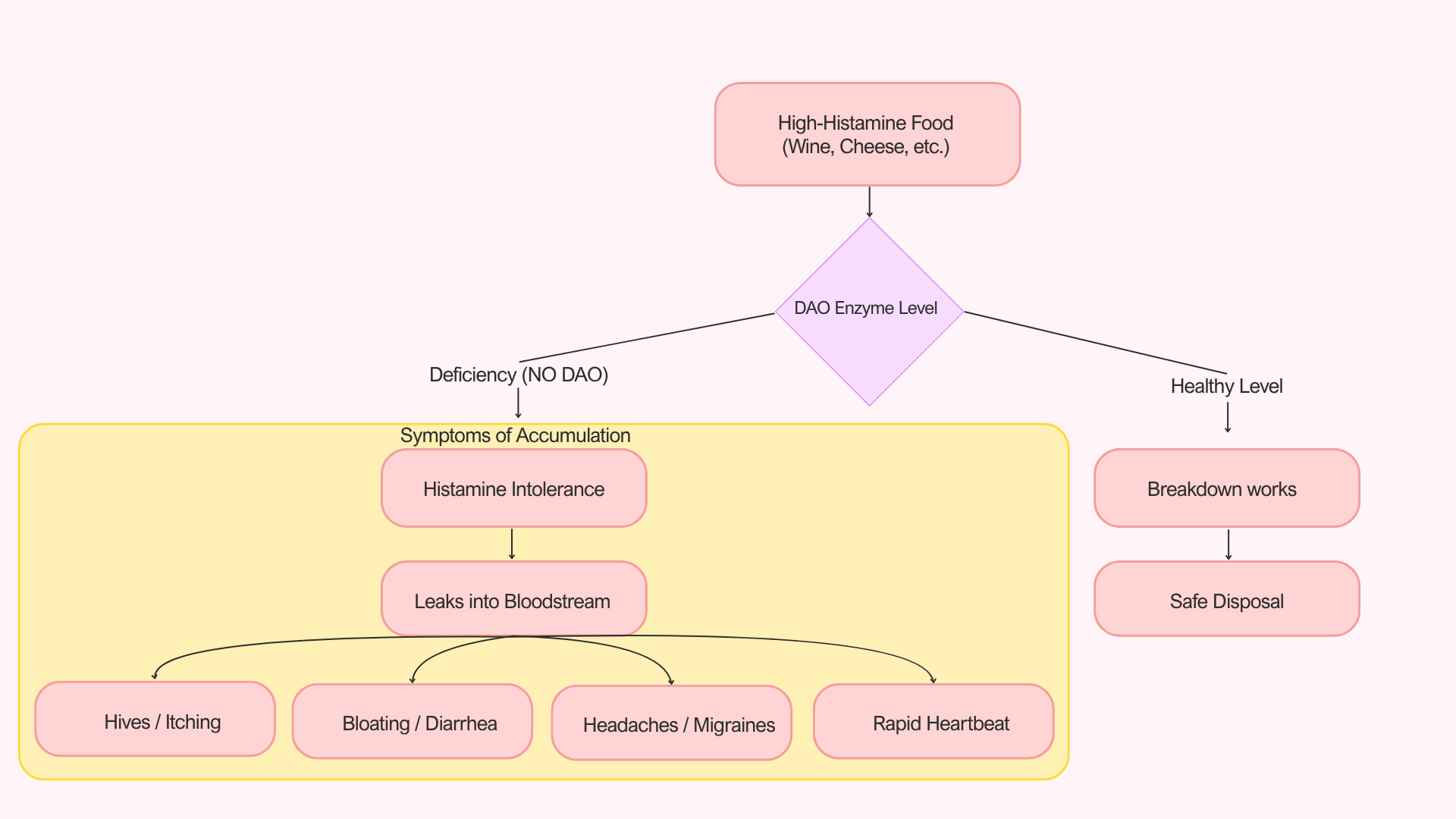
Like most things in the body, histamine must be carefully regulated. Enter diamine oxidase, or DAO, the enzyme responsible for breaking down histamine absorbed from food. DAO is primarily found in the gut and kidneys, and its job is to prevent histamine from accumulating to problematic levels.
Worth noting: both alcohol consumption and certain medications can suppress DAO activity, which is one reason a glass of wine can trigger a flushing response or headache in some people.
Hope the chart below helps you understand this vast concept.
When Histamine Works For You
Histamine gets a bad reputation, but it serves several essential functions:
Immune defence: It initiates immune responses and facilitates the widening of blood vessels, allowing immune cells to reach tissues where they are needed most.
Sleep regulation: Histamine plays a key role in the sleep-wake cycle, keeping you alert and awake during the day.
Digestion: It stimulates the release of gastric acid in the stomach, supporting proper digestion
When Histamine Works Against You
Problems arise when histamine is produced in excess, or when the body cannot break it down efficiently.
If the immune system overreacts to a harmless substance, mast cells flood the body with histamine, triggering a wide range of symptoms that can feel scattered and confusing when you do not know what connects them. Here is how excess histamine commonly shows up:
On the skin:
Hives (urticaria) and welts
Flushing and redness, especially on the face, chest, and neck
Intense itching (pruritus)
Eczema and dermatitis flares
Swelling, including around the eyes and lips
In the sinuses and airways:
Chronic nasal congestion and stuffiness
Runny nose with clear discharge
Postnasal drip
Frequent sneezing, especially in the morning or after eating
Itchy, watery, or red eyes
Sinus pressure and sinus headaches
Sinus-related ear fullness or popping
Recurrent sinusitis or sinus infections
Throat clearing, tickling, or a persistent mild sore throat
Shortness of breath or airway tightening in those prone to asthma
In the gut:
Bloating, gas, and cramping
Nausea
Diarrhea or loose stools
Constipation
Reflux or heartburn
In the nervous system and whole body:
Headaches and migraines
Brain fog and difficulty concentrating
Fatigue, especially after meals
Anxiety and a sense of inner restlessness
Heart palpitations
Low blood pressure or dizziness upon standing
Difficulty falling or staying asleep
Temperature sensitivity, feeling overheated easily
When histamine intolerance is present, this collection of seemingly unrelated symptoms often gets investigated separately for years, with no clear answer. Connecting them back to histamine is often the missing piece.
Does this resonate with you - Yes, you are right to get on that free health discovery call, It's that simple, Do not live with these symptoms.Book a discovery call
Foods That Are High in Histamine ( Something to be mindful of)
Processed and cured meats: bacon, sausage, deli meats
Alcohol: particularly beer and wine
Seafood: canned fish (tuna, sardines, mackerel), shellfish
Vegetables: spinach, tomatoes, eggplant, avocado
Fruits: citrus, strawberries, pineapple, banana
Nuts: almonds, hazelnuts
Fermented foods: kimchi, sauerkraut, kefir, kombucha
Condiments: vinegar, soy sauce, ketchup, cinnamon
Cheese: aged, blue, and smoked varieties
Other: tea, egg whites, chocolate, bone broth
Managing Histamine Levels Naturally
Keeping histamine in a healthy range involves a combination of dietary and lifestyle strategies:
Have a personalized nutrition plan to help alleviate your symptoms.
Reduce or temporarily eliminate high-histamine foods to identify your personal triggers
Avoid known allergens and environmental irritants
Prioritize stress management, as stress is a direct mast cell trigger
Support gut health, since a compromised gut lining is closely linked to DAO deficiency
Consider natural antihistamine support, including vitamin C, quercetin, and targeted supplementation tailored to your individual needs
The Bottom Line
Think of histamine like a smoke alarm. When it goes off, something is calling for your attention. But when the alarm becomes hypersensitive, triggered by things that pose no real threat, the solution is not to ignore it. It is to understand what is setting it off, and to bring the system back into balance.
I have been there personally, and I have walked many clients through this same unraveling. When you start eating and living in a way that supports your own unique biochemistry, the body has a remarkable ability to recalibrate.
If you suspect histamine may be playing a role in your symptoms, I would love to help you get to the root of it.
Book a discovery callor send me a DM on Instagram@reformandheal.
Reference Sources:
Patel, R. H., & Rahimi, N. (2026). Biochemistry, histamine. In StatPearls. StatPearls Publishing.https://www.ncbi.nlm.nih.gov/books/NBK557790/#article-78280.s6
Hough, L. B. (1999). Histamine actions in the central nervous system. In G. J. Siegel, B. W. Agranoff, R. W. Albers, et al. (Eds.), Basic neurochemistry: Molecular, cellular and medical aspects (6th ed.). Lippincott-Raven.https://www.ncbi.nlm.nih.gov/books/NBK28245/
Fiorani, M., Del Vecchio, L. E., Dargenio, P., Kaitsas, F., Rozera, T., Porcari, S., Gasbarrini, A., Cammarota, G., & Ianiro, G. (2023). Histamine-producing bacteria and their role in gastrointestinal disorders. Expert Review of Gastroenterology & Hepatology, 17(7), 709–718.https://www.tandfonline.com/doi/full/10.1080/17474124.2023.2230865
Maintz, L., & Novak, N. (2007). Histamine and histamine intolerance. The American Journal of Clinical Nutrition, 85(5), 1185–1196.https://www.sciencedirect.com/science/article/pii/S0002916523280533
Jochum, C. (2024). Histamine intolerance: Symptoms, diagnosis, and beyond. Nutrients, 16(8), 1219.https://pmc.ncbi.nlm.nih.gov/articles/PMC11054089/
American College of Allergy, Asthma, and Immunology. (n.d.). Hives (urticaria).https://acaai.org/allergies/allergic-conditions/skin-allergy/hives/
Altomara, D. (2024, May 22). Foods high in histamine. WebMD.https://www.webmd.com/diet/foods-high-in-histamine